Revid AI Review 2026: 474 Shorts & 3.4M Views From a 4-Month Test
I built Sussurri Horror, an Italian faceless horror channel, on Revid as a time-boxed test. Between January and May 2025 I published 474 Shorts with no camera and no editor. This review covers what the real numbers say, what Revid costs today, and who should (and shouldn't) pay for it.
Affiliate disclosure: I earn 20% of what you pay if you subscribe through my link or code. It doesn't change the numbers below, including the ones that don't flatter Revid.
The short verdict
Revid does what it promises: one tool turns an idea into a captioned, voiced, published Short. It let one person ship 474 of them in about 18 weeks. The thing to plan for is credits: volume is where the results come from, and volume is what you pay for.
Solo creators testing a faceless niche, marketers who need volume, anyone ready to post consistently.
You need the channel to fund the tool from month one, or you want premium AI-video visuals on the entry plan.
$39/mo Growth (2,000 credits), $32/mo billed yearly. Ultra $199/mo. Checked on revid.ai, 12 Nov 2026
The channel data: what 474 Shorts actually did
No screenshots of a dashboard you can't check. These numbers come straight from the YouTube Data and Analytics APIs for @sussurri_horror, and the channel is public, so you can verify the totals yourself.
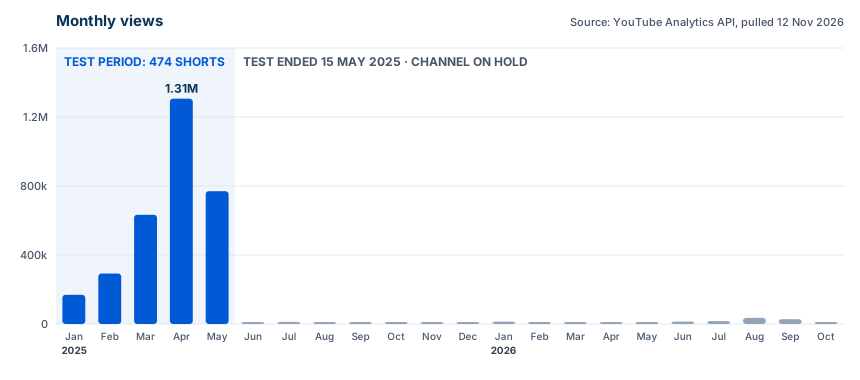
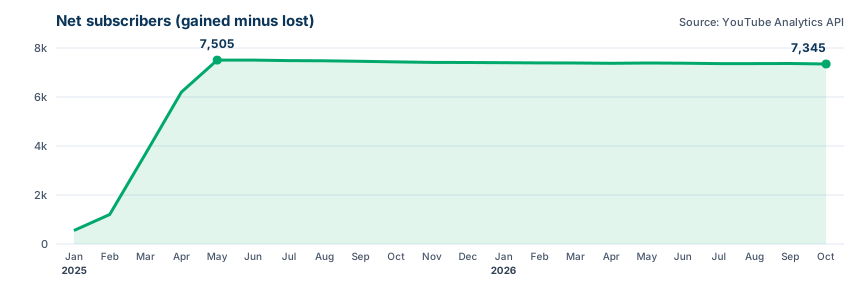
The channel launched on 10 January 2025. The first Short went up the same day and the last one of the test on 15 May 2025. The median Short got 3,799 views, 99 of them passed 10,000, and the best one, a horror version of the Frozen characters, reached 268,268. Over the channel's life it gained 8,965 subscribers and lost 1,622.
The five most-watched Shorts
- Versione horror dei personaggi di Frozen268,268 views · 10 s · 27 Jan 2025
- Bambola antica entra nei sogni: non dormire mai con lei65,037 views · 29 s · 12 Mar 2025
- Rumori di notte in casa: chiudo la porta o mi nascondo?58,370 views · 28 s · 3 May 2025
- Versione zombie dei personaggi di Frozen50,465 views · 11 s · 5 Feb 2025
- Passi fuori dal bagno: blocco la porta o mi nascondo?47,488 views · 28 s · 6 May 2025
View counts from the YouTube Data API, 12 Nov 2026.
Where the channel is now
Sussurri Horror was a planned, time-boxed test. The question was simple: how far can a fully automated faceless Shorts channel on Revid go in about four months, run by one person with no camera and no editor?
The test hit its goals. Once it ended, my focus went back to my AI enablement and AI operations consulting work, so the channel is on hold for now. I plan to restart it later, and the audience it built is still there.
One thing the data makes clear: Shorts reach follows publishing. While the test was running, the Shorts feed kept serving new videos. Since the channel went on hold, views have settled at a few thousand to a few tens of thousands a month. If you want sustained growth, plan for consistent output from day one.
What Revid actually does
Most AI video tools do one job: clipping, captions or voiceover. Revid covers the whole pipeline. You give it an idea, a link, a song or a viral video to remix, and it writes the script, builds the visuals, adds the voiceover, syncs captions and publishes to TikTok, Instagram, YouTube and X. Revid also offers an API, an MCP server and a CLI on every paid plan. These are the parts I relied on:
Auto-Mode (formerly Autopilot)
Set the niche, format and schedule once; Revid writes, renders and queues the Shorts. Your job becomes reviewing the queue. The setup took me about two weeks of tuning before I was happy with what it produced.
Remix viral videos
Paste a TikTok or Reel URL and Revid rebuilds its structure (hook, pacing, format) around your own content. The idea is to reuse the format, not to copy the content.
Prompt to Video
One sentence in, a generated clip out. Revid now offers models like Seedance 2.5 and Veo 3, but they're the most credit-hungry option on the platform. See the cost table below.
UGC ads and avatars
AI presenters for product ads. I used this for client work, not the channel. It's relevant if you test ad angles every week.
Real cost per video
I don't have per-render credit logs from 2025, so this table uses Revid's own published credit costs (checked 12 Nov 2026) and divides them into today's Growth plan. Use the in-app "Estimated cost" before every render, because the model you pick changes the bill more than anything else.
| 30-second Short made with | Credits (Revid's figures) | Videos on Growth (2,000) | Cost per video at $39 |
|---|---|---|---|
| AI images + voiceover (Pro) | ~40–80 | ~25–50 | ~$0.78–$1.56 |
| Pro AI video + voiceover | ~300 | ~6 | ~$5.85 |
| Seedance 4K AI video | ~3,000 (500 per 5 s) | 0 (exceeds the plan) | Needs a bigger plan or a Boost pack |
Sources: revid.ai/pricing, revid.ai/llm/revid-ai-credit-costs.md and Revid's credits guide. Billed yearly, Growth drops to $32/month, so image-based Shorts come out around $0.64–$1.28 each. Plan credits refill each month and don't roll over.
What a 26-Shorts-a-week pace costs
To help you pick a plan, here's the math for the pace of my test: about 26 Shorts a week, or roughly 110 a month. These are calculations from Revid's published credit costs, not a billing statement.
Want to see the estimate for your own format? Sign up, build one Short, and check the "Estimated cost" before you render.
Revid AI pricing in 2026
Revid has changed its plans since my test. This is the current lineup, from the live pricing page on 12 Nov 2026. There's no free plan: you can sign up without a card and new accounts get some free credits to try generation, but regular creation runs on a paid plan's credits.
| Plan | Monthly | Billed yearly | Credits / month | Notes |
|---|---|---|---|---|
| Hobby | $39 | – | Not listed | Create from text or links, remix library, for occasional hands-on use |
| Growth | $39 | $32/mo | 2,000 | Publishing to TikTok, IG, YouTube, X; 100+ tools; 3 Auto-Mode workers; API, MCP, CLI |
| Elite | $89 | $74/mo | 5,000 | Offered to existing subscribers; voice cloning; 5 Auto-Mode workers |
| Ultra | $199 | $166/mo | 12,000 | 10 Auto-Mode workers; slider up to 200,000 credits ($2,799/mo) |
Credit Boost packs top up a balance without changing plan: 1,000 credits for $49, 4,000 for $99, 10,000 for $199. Boost credits don't expire. Hobby and Growth showing the same $39 price is confusing; Growth is the one that includes publishing and the full toolset, so compare the two before you pick.
How I ran the channel, step by step
This was my workflow during the test. Revid's interface has changed since, so feature names may differ slightly.
Pick a narrow niche
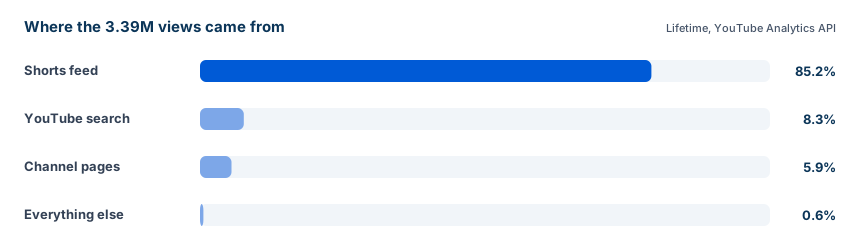
Not "AI content" but "Italian horror Shorts for a late-night audience". A narrow niche makes the scripts easier and helps the Shorts feed find the right viewers. Language counts too: 92% of my views came from Italy.
Connect your accounts
Connect YouTube, TikTok or Instagram through each platform's own authorization. You can revoke access from your Google or TikTok account at any time.
Set up Auto-Mode
Topic, format, tone, visual style, caption style and schedule. Treat this as a two-week tuning job, not a ten-minute setup. Vague briefs produce generic Shorts.
Review the queue
Skim the scripts, cut anything off-brand, sharpen weak hooks, then approve the batch. Never publish unreviewed: AI scripts can invent details and mis-transcribe unusual words.
Mix in manual pieces
Remix a format that's already performing, or generate a standout clip with Prompt to Video, but check the credit estimate first.
Read the analytics, then pick your plan
Watch which hooks hold viewers past the first two seconds. My average view lasted 22 seconds, so the opening frame did most of the work. Once you know your pace, match the plan to it using the cost section above.
Honest cons
1. Volume is what you're paying for. My test's growth came from publishing about 26 Shorts a week. At that pace you're past the entry plan, so size the plan to your schedule.
2. Shorts reach follows publishing. Views dropped sharply the month after the test's last upload (769,990 in May 2025, 10,844 in June). Whatever tool you use, plan for consistent output.
3. Premium AI-video models burn credits fast. A 30-second Pro AI video is about 300 credits, roughly six videos on Growth. Templates and AI images are far cheaper.
4. Credits don't roll over. Unused plan credits reset at renewal, so a light month is money lost. Boost packs are the exception.
5. Output still needs a human. I saw occasional mis-transcribed words and stock visuals that missed the brief. Public reviews on Trustpilot and Capterra also mention credits spent on failed generations and strict refund rules. Check the estimate, and review every Short before it goes live.
Revid vs the real alternatives
Pictory and Opus Clip mostly repurpose footage you already have, so they're a different job. These are the tools people actually compare with Revid for faceless Shorts. Prices are from each tool's own site, checked 12 Nov 2026.
| Tool | Best at | Entry price | Posts for you | Pick it if |
|---|---|---|---|---|
| Revid | Research, script, visuals, voice and publishing in one tool; API | $39/mo (2,000 credits) | Yes: TikTok, IG, YouTube, X | You want one tool for the whole pipeline |
| AutoShorts.ai | One faceless series on a fixed schedule | $19/mo (1 series, 3 posts a week) | Yes | You run a single channel at a modest pace |
| Faceless.video | Budget autopilot with rollover credits | $20/mo (up to 15 videos) | Yes (1 account on Starter) | You want credits that don't expire |
| Crayo | Clipping long videos into Shorts (AutoClip) | $19/mo billed quarterly | Not listed on its pricing page | You already have podcasts or streams to clip |
| InVideo AI | Prompt-to-video plus a full timeline editor | $10/seat/mo billed yearly | Not listed on its pricing page | You want to edit every video by hand |
If you only want to test a niche at low volume, AutoShorts.ai and Faceless.video are cheaper starting points. Revid is worth the price when you need volume, remixing and publishing in one place. More head-to-heads: Revid vs Opus Clip and the best AI video tools in 2026.
Frequently asked questions
Is Revid AI worth it in 2026?
Yes, if you can commit to consistent output. In my four-month test it let me publish 474 Shorts and reach 3.38M views and 7,340 subscribers. On a tighter budget, start on Growth at a lower pace and scale up once the results justify it.
How much does Revid AI cost?
Growth is $39/month ($32/month billed yearly) with 2,000 credits. Elite is $89/month with 5,000 credits for existing subscribers, and Ultra is $199/month with 12,000 credits. Prices checked on revid.ai on 12 Nov 2026.
Does Revid AI have a free plan or free trial?
There's no free plan. You can sign up without a credit card, and new accounts get some free credits to try video generation. Regular creation uses a paid plan's monthly credits.
How many videos can you make with 2,000 Revid credits?
According to Revid, a 30-second video with Pro AI images and a voiceover costs about 40 to 80 credits, so 2,000 credits cover roughly 25 to 50 of them. A 30-second Pro AI video costs about 300 credits, roughly six a month.
Do Revid credits roll over?
No. Plan credits refill to your plan amount at each renewal. Credit Boost packs, sold separately, don't expire.
Can Revid post to YouTube automatically?
Yes. Revid publishes directly to YouTube, TikTok, Instagram and X once you connect the accounts, and Auto-Mode can create and queue posts on a schedule.
What is the best Revid AI alternative?
For a single faceless channel on a budget, AutoShorts.ai (from $19/month) or Faceless.video (from $20/month). For clipping long videos, Crayo. For hands-on editing, InVideo AI. Revid stays the pick for an all-in-one pipeline with remixing, publishing and an API.
A strong production engine. Plan your volume, then pick the plan.
Revid let me run a 474-Short test channel on my own and reach 3.4M views in four months. Start with a small test on your niche, check the credit estimate for your format, and only scale once the numbers work for you.
Paid plans from $39/month · Sign up without a card · Free credits for new accounts
Stay in the loop.
Technical breakdowns, new system builds, and lessons from deploying autonomous AI. One email a week, direct to your inbox.
Weekly architectural updates. Unsubscribe anytime.